14 Human Rights Wins To Celebrate In 2025
Here’s to another year of fighting for the world we want to see.

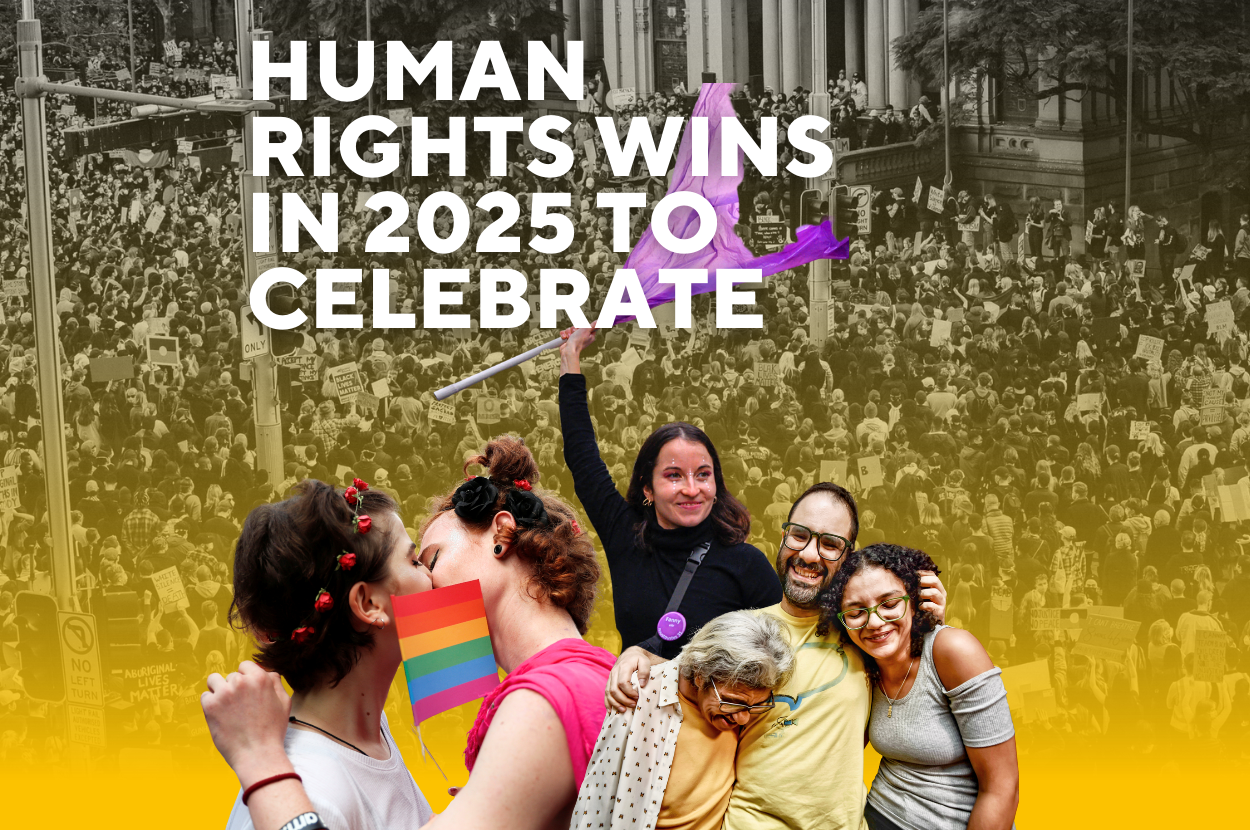
Progress is always possible.
In 2025, countries all around the world made strides towards a more free, just and equal world, reminding us that activism works when people come together.
Here’s to another year of fighting for the world we want to see.
1. France and Norway both passed an "only yes means yes" law clearly defining rape as sex without consent
France has passed a “only yes means yes” law that clearly defines rape as sex without consent.
Previously, rape in France had been defined mainly by the presence of violence, coercion, threats or surprise.
Now, according to the new law the parliament passed on Wednesday, Oct. 29, all sexual acts without consent constitute rape.
As of Friday, June 6, any sex without clear and explicit consent is also legally considered rape in Norway, even if there was no violence or physical force.
2. Italy officially made femicide — the murder of woman or girl due to her gender — a crime
Italy has officially made femicide – the murder of a woman or girl because of her gender – a crime, with a punishment of life in prison.
The move came after Giulia Cecchettin, a 22-year-old student was stabbed to death by her ex-boyfriend, in 2023.
The case shocked the country and sparked a conversation about the causes of violence against women in Italy’s patriarchal culture.
On Tuesday, Nov. 25 — the International Day for the Elimination of Violence against Women — the parliament unanimously approved the law to include femicide in Italy’s criminal law.
3. The ICJ found that climate change is an existential threat and countries must act to stop it
The International Court of Justice (ICJ), the world’s highest court, has delivered a landmark ruling that found climate change is an “existential threat” and that countries have a legal responsibility to protect the environment and cut their emissions.
The ruling came six years after a group of students across the Pacific Islands, the Pacific Island Students Fighting Climate Change (PISFCC), launched a campaign for the ICJ to issue an advisory opinion — or its legal opinion — on the link between climate change and human rights.
4. Saint Lucia found the country’s ban on gay sex is unconstitutional
The Caribbean country of Saint Lucia has struck down colonial-era laws making gay sex a crime.
Due to a law imposed during British colonial rule in the 1800s, sexual activities between two men are banned in Saint Lucia, even if both people had consented.
But on Tuesday, July 29, the country’s high court struck down the law banning “buggery” and “gross indecency”, ruling it was unconstitutional and violated fundamental human rights.
Saint Lucia is the 5th Caribbean country to have struck down bans on gay sex following Barbados, Antigua and Barbuda, Saint Kitts and Nevis and Dominica.
5. Egyptian activist Alaa Abd El-Fatah was finally freed after 12 years in prison
43-year-old Abd El-Fattah became a leading voice in the Egyptian Revolution in 2011, rising to prominence for his role in the protests and documenting events despite the government crackdown.
He has been jailed and released multiple times since 2006, mainly for organizing protests.
Despite his sentence effectively ending on Sept. 29, 2024, Egyptian authorities continued to detain him, saying they had decided not to count his pre-trial detention and pushing his release date to January 2027.
On Monday, Sept. 22, Abd El-Fattah was granted a presidential pardon with six other prisoners, following a request from the National Council for Human Rights, according to local news.
7. Malta made period products free for all students in middle and high school to reduce period poverty
The government of Malta will install some 142 vending machines with two types of sanitary pads and one type of tampon across 58 schools across the country.
The government said the plan, which it is investing €439,000 into, will help to eliminate stigma, normalize open discussions about periods and menstrual health and ensure no student has to miss out on educational opportunities because they don't have access to period products.
This is another step in the global effort to reduce “period poverty,” when people cannot access basic sanitary products when they need them.
8. The EU’s top court ruled that all member countries must respect same sex marriage
The ruling came after a same-sex Polish couple sued the Polish government for not recognizing their same-sex marriage.
The case made its way to the European Court of Justice (ECJ), which ruled on Tuesday, Nov. 25 that that Poland was wrong not to recognize the marriage just because its own laws do not permit same-sex marriage.
The court said that EU member states are not required to change their national laws to allow same-sex marriage.
But countries are not allowed to discriminate against same-sex couples when recognizing foreign marriages.
9. Namibia made all public universities free for students starting 2026
Namibia already provides free education at public primary and secondary schools, but on April 24, Namibia’s first woman president Netumbo Nandi-Ndaitwah announced in her first speech to parliament that starting in 2026, students will no longer have to pay tuition or registration fees at public universities and technical colleges.
“We have heard your cries,” she said to young people during her address, adding that the move will help create more opportunities for Namibia’s large youth population, especially as the country struggles with high rates of unemployment.
The decision will cover two public universities and all seven government-run training centers in the country, according to Africa Briefing.
10. Poland abolished its last “LGBTQ-free” zone
Between 2019 and 2020, more than 100 towns in Poland — or about a third of the country — had declared themselves to be “LGBTQ-free zones”, or areas completely free of "LGBTQ ideology".
In 2023, people in Poland proceeded to vote out the right-wing government after eight years, electing a center-right government.
Over time, this led to all of the regions to eventually withdraw their declarations, with Łańcut, a town in south-east Poland becoming the final holdout.
And on Thursday, April 24, Łańcut voted to revoke its “LGBTQ-free zone”, making all of Poland now a LGBTQ-friendly zone.
11. Japan allowed women to buy the morning-after pill over the counter for the first time
Previously, women in Japan had to go to a clinic or hospital in order to get a prescription for emergency contraception, even if they have been sexually assaulted.
In 2023, Japan began a trial that allowed pharmacies with trained pharmacists and private rooms to sell the morning-after pill.
The change means the morning-after pill can now be bought at pharmacies without a prescription, age limit, or parental consent.
The move came after the country finally approved the abortion pill in April 2023.
12. Saudi woman Salma al-Shebab was freed after being jailed for 34 years for retweeting activists
Salma al-Shehab, who was studying her PhD at the University of Leeds, was detained when she returned to Saudi Arabia for a holiday in January 2021.
She was initially sentenced to six years for the “‘crime’ of using an internet website to ’cause public unrest and destabilize civil and national security’,” according to the Guardian.
However, her sentence was then increased to 34 years followed by a 34-year travel ban, making it the longest known sentence for a women’s rights activist in Saudi Arabia, according to the Freedom Initiative, a non-profit advocating for prisoners wrongfully detained in the Middle East and North Africa.
Her sentence was later reduced twice, first to 27 years and, then to four years with an additional four years suspended.
On Monday, Feb. 10, ALQST, a London-based Saudi rights group, confirmed Shebab had been released, but there has been no official acknowledgment from Saudi authorities.
13. Cuba passed a law for trans people to change their legal gender without needing to undergo surgery
On July 18, Cuba’s parliament passed a law that will allow trans people over the age of 18 to change their legal gender without needing to undergo surgery.
LGBTQ activists have welcomed the move, saying it is a step forward in fighting discrimination against the LGBTQ community after Cuba legalized same-sex marriage in 2022.
14. Belarus freed over 100 political prisoners, including activists and opposition leaders
Belarus has released 123 prisoners, including prominent opposition figures Maria Kolesnikova and Nobel Peace Prize winner Ales Bialiatski, after the US lifted sanctions on Belarusian potash.
Most of those freed had been jailed following protests against Belarus’ disputed 2020 presidential election, in which president Alexander Lukashenko claimed a sixth term in a vote widely regarded as rigged.
The US and EU then imposed sanctions on Belarus, with additional measures introduced after Minsk allowed Russia to use its territory to invade Ukraine.
Belarus’ announcement to free the prisoners on Saturday, Dec. 13, came after two days of talks in Minsk between Lukashenko and the US’ special envoy John Coale, to remove sanctions on Belarusian potash exports, a key fertilizer component that Belarus is a leading global producer of.
You Might Also Like
 Kassy Cho
 Kassy Cho
 Kassy Cho